
Work and craft have long been part of daily life in Grottole. Skills were passed down not as abstract traditions, but as practical knowledge tied to place, materials, and the need to make a living. Making here has always existed alongside farming and daily labor, shaped by necessity as much as by creativity.
Several practices visible in the village today—ceramics, honey, olive oil, and grain—reflect how tradition in Grottole continues through both continuity and adaptation.
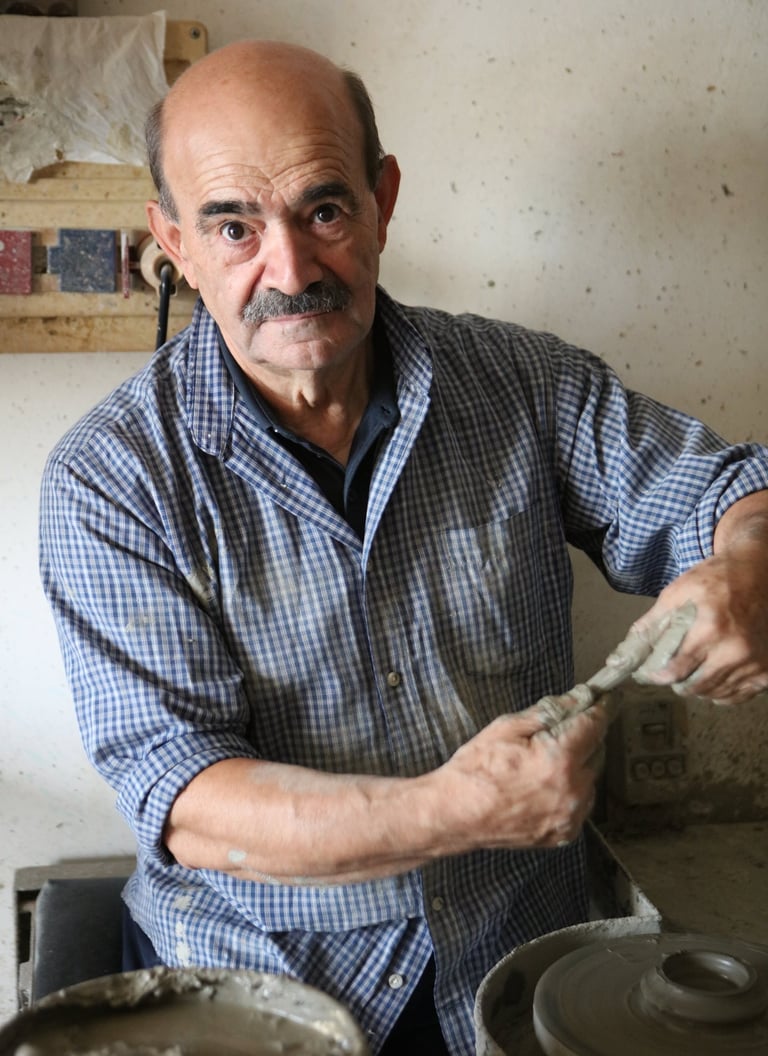
Ceramic making has deep roots in the village, shaped by local materials and everyday use. This tradition continues today through Nisio, a master potter, artist, and professor whose family has lived in Grottole for generations. He maintains a working studio in the village, as well as a second studio in the Sassi of Matera, linking Grottole’s living tradition to a wider historical and cultural landscape.
Nisio’s work reflects the reality of a practicing artisan. His studio includes a range of pieces: pottery made to support a livelihood, traditional forms rooted in daily use, and more personal artistic works developed through experimentation and expression. A simple walk through his studio shows this full spectrum. Among the most enduring pieces are traditional objects—plates, bowls, and vessels—finished with distinctive artistic treatments. These are items meant to be used in everyday life, continuing the close relationship between craft, food, and the kitchen.
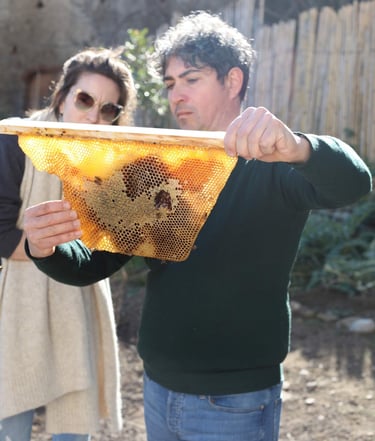
Honey production represents a more recent chapter in Grottole’s working life, but one equally grounded in care, knowledge, and attention to place. The village has come to be known locally as a “city of honey,” in part due to the work of Rocco, a lifelong resident and village barber who is also a dedicated beekeeper. His involvement with bees is pursued with patience and genuine passion, alongside his daily life in the village.
Rocco’s beekeeping follows the landscape. His hives are rotated through different natural environments surrounding Grottole over the course of the year, following flowering cycles and seasonal changes. This allows each harvest to reflect specific moments in time, shaped by wildflowers, fields, and native growth rather than standardized production. Honey here becomes a record of season and terrain.
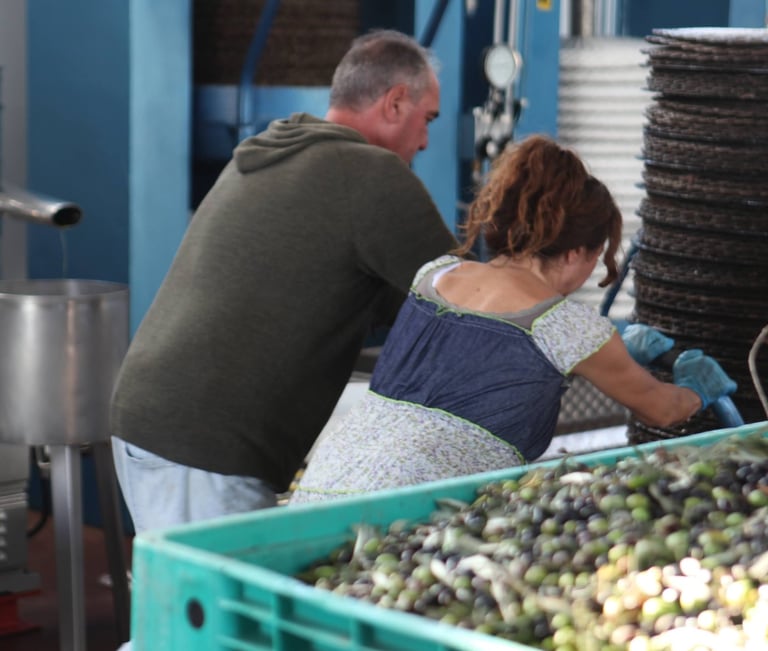
Olive oil follows a similar rhythm. Grottole has its own frantoio, where olives from the surrounding hills are pressed each season. During the harvest, the frantoio becomes a shared point of activity, with families bringing in olives gathered from their own trees and leaving with oil that reflects the year’s weather, soil, and care. Olive oil here is not branded or marketed; it is recognized by taste, origin, and the people who produced it.
Grain, too, shapes daily life. The fields surrounding the village are planted with wheat that is milled and used for locally made pasta, continuing a long cycle that connects agriculture, food, and everyday meals. Like olive oil, this is not production for display, but for use—quietly sustaining kitchens and tables through familiar, repeated practice.
Equally important across all of these crafts is the sharing of knowledge. Rocco regularly volunteers his time to teach school children about beekeeping, helping them understand the role of bees, the seasonal nature of the work, and the connection between agriculture and ecology. Teaching, in this sense, is not separate from the craft—it is part of how it continues.
What unites ceramics, honey, olive oil, and grain in Grottole is not the product, but the attitude toward making. These practices are sustained by people who are deeply engaged in their work and generous in sharing it, whether with local residents or with foreigners who take the time to learn. Knowledge here is not packaged or promoted; it is passed on through conversation, demonstration, and sustained interest.
In this way, craft in Grottole remains a living practice. It continues not because it is preserved, but because people care enough to adapt, to teach, and to keep working with their hands in ways that make sense within village life.
Contact
For inquiries about life in Grottole.
© 2026 All rights reserved.
Iryna@lifeingrottole.com
Questions@lifeingrottole.com
Stay@lifeingrottole.com